

 Latest Review




 April 16, 2025

For our next Enthusiast Spotlight, we’re featuring Los Angeles-based filmmaker, Van Neistat. As the creator of The Spirited Man on YouTube, Van inspires others to live more intentionally—while surrounding himself with objects built to last and learning how to make them last even longer.
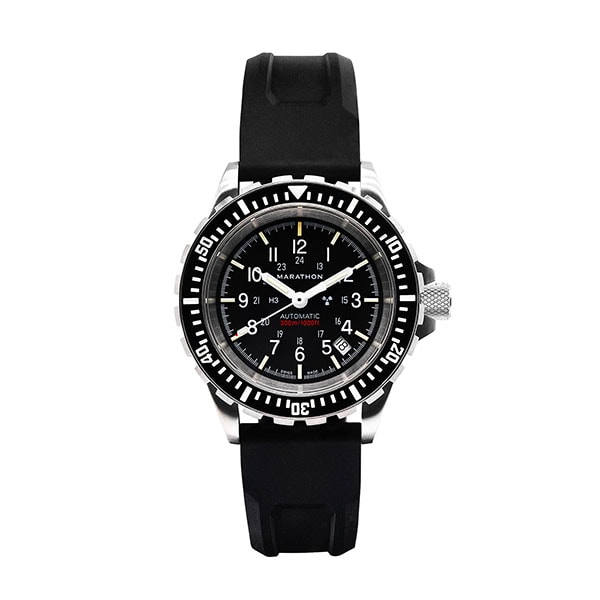
Recently, we noticed him sporting a dive watch with a bold bezel that looked a lot like a Marathon dive watch. A quick check confirmed it—he’d discovered Marathon and become a fan. We caught up with him at his Calabasas studio, where he crafts video essays ranging from DIY guides to deep dives into self-betterment. And, in partnership with Marathon, we’ve sponsored a video exploring Van’s personal watch journey and philosophy that led him to his own Marathon 41mm GSAR Type II Diver’s Automatic.


Van, thank you so much for speaking with us today. You are a writer, filmmaker, and artist who’s synthesized your talents into The Spirited Man Channel on YouTube—can tell us a bit about how you got your start and boil down the ethos of your efforts for our audience?
I got my start back in 2000 with the iMac DV—a game-changer at the time. With a Sony TRV-8 camera and a FireWire cable, I could finally import footage without a $40,000 editing system. So, I took my tax return, bought the iMac DV, and began digitizing hours of VHS footage my mother had shot, condensing it into a one-hour home movie. That was my first editing project for fun. After that, I spent 16 years making videos, worked with my brother on the HBO series The Neistat Brothers (essentially a YouTube channel on cable television), and collaborated with artist Tom Sachs for over a decade, culminating in the feature film A Space Program. But after years of structured work, I realized I hadn’t made anything purely for myself in a long time—and that’s when I made my first episode of The Spirited Man.
The name comes from Shop Class as Soulcraft by Matthew B. Crawford, a book that celebrates those who work with their hands while engaging deeply with ideas. It introduced me to the concept of the “gearhead bookworm.” The book describes how a ‘spirited man’ doesn’t just take his car to the mechanic—he wants to understand what’s wrong with it. I identified with this philosophy: being hands-on, self-reliant, and engaged in the world around us. And that’s partly what The Spirited Man is all about. A “spirited man” is, as Crawford put it, basically someone who takes care of his own business.


Surrounding yourself with the right objects seems to be a big part of your creative process. They almost always seem to be possessions that inspire, last the test of time, and have a bit of soul. What kind of requirements do you place on the items you surround yourself with?
There’s this legendary NASCAR pioneer, Smokey Yunick—one of the first great engine builders. He was a master mechanic who wore an all-white jumpsuit in the shop, and it was always immaculate. He had a saying about race cars: “Reliability above all.” A lot of the things I make or modify are about increasing reliability—sometimes making something more dependable than it was originally, sometimes making myself more reliable by adapting what I use. Other times, the things I need just don’t exist, so I have to make them myself. That means they have to fit within my skill set, which is pretty limited. I’m not a master of anything—I’m more of a hobbyist, a dilettante—so I have to work with the materials and tools I know.
I’ve definitely borrowed a sense of aesthetics and functionality from Tom Sachs—how things should be built, how rough or refined they should look. I grew up in New England, where things are built to last. In my old neighborhood, there are 18th century houses that are still standing. I went to the College of William & Mary, which was founded in 1693. I have a weakness for things that are meant to endure.


I’ve noticed in our interactions, you value your time. Can you talk a bit about the importance of time to you, to your family, and to your creative process?
Andrei Tarkovsky, the great Russian filmmaker, said that filmmaking is sculpting in time. More than almost any other creative discipline—even more than music—filmmaking demands an acute sense of time. Editors, for instance, are masters of time. They work in increments of 1/24th of a second. I’ve also noticed that editors, as a group, tend to be extremely punctual. There’s an editor I know whose son plays on my son’s soccer team, and she is always on time—not early, not late, on time.
Since smartphones have become ubiquitous, it’s way too easy to call or text, “Hey, I’m running five or ten minutes late.” But being on time matters. I actually made a video about punctuality, called: Your Tardy Friends Suck. So when my friends are egregiously late, I just send them the link. They say timeliness is next to godliness… or no, that’s cleanliness. Well, it should be timeliness.

Over time, you’ve carefully curated your “Spirited Man” uniform. It’s function-first, workwear-inspired. Can you talk about how you’ve curated and modified your fit to optimize it for your everyday work?
I dress like I probably work here. I wear Carhartt pants, but I cut off the hammer loop because it catches on things and knocks them over. I’m naturally clumsy. These pants fit me perfectly straight off the rack—no alterations needed—so I order two to four pairs a year. The iPhone Pro (not the Pro Max) slides perfectly into one of the tool pockets, locking in just enough that it won’t fall out but is still easy to grab. Carhartts also come in two key colors—caramel and black. The caramel fades beautifully and hides dirt well, while the black ones are my go-to when I’m riding my motorcycle or working on an engine. I always get the double-knee version because it extends their lifespan—if the knee wears out, it doesn’t go straight to the skin. In the summer, I switch to white Roundhouse painter’s pants. I remove the factory label and sew my own onto the back pocket.
For boots, I wear Limmers. They’re the cheaper ones, but they’re still expensive—because they’re built to last a lifetime. They have a single seam with six rows of stitches, which was Peter Limmer’s innovation. As for shirts, years ago, a guy I used to work with named BC Slice gave me a box of brand-new Red Kap work shirts from his union job. They were the perfect shade of blue but didn’t fit me well, so I got them tailored. Isabel ordered me a bunch as a gift, and then had my labels sewn in. My jacket is a Japanese denim chore coat from Flint and Tinder. I sewed a little pencil slot into the pocket because I’m dead in the water without a pencil. The uniform simplifies my life and lets me connect with people, probably because I look like a workin’ man. It’s kind of like stolen valor, I suppose.


Our community has a fascination with all things mechanical, watches, of course being the primary example. But we also love cars, trucks, bikes, and clocks. What is it about these moving, ticking objects that inspire us?
I love to listen to Jerry Seinfeld talk about cars. I heard him recently on The Smoking Tire podcast. He said something like, “Let me just go ahead and tell you the question I anticipated you asking me. Why Porsche? Of all of the cars, why are Porsches the ones that you’re drawn to?” And so Seinfeld answers his own question and he says: “It’s the philosophy. It’s the philosophy of the car. The way it’s built, why it looks the way it looks, is because of the philosophy of it.”
One of the things we love about beautiful, mechanical things is… they do the job. They do the job. Great scissors will cut 100% of the time. They do the job. They’re beautiful for doing it. The engineers, designers, builders, and fabricators… some of them just elevate these things to such a great level that they actually will transmit a feeling into the person who beholds them. Art is a medium through which an artist transmits a feeling to an audience. That’s Leo Tolstoy’s definition of art. There are some objects, especially mechanical ones, like motorcycles and Land Cruisers, that will give me a zing, a jolt… merely at the sight of them.


So the Marathon GSAR Diver’s Automatic is kind of the Toyota Land Cruiser of watches. Can you tell us how you discovered Marathon, what drew you to this model, and how it’s become the newest addition to your uniform?
Maybe it’s actually the Toyota Hilux of watches. There’s a YouTuber called WhistlinDiesel who had a diesel Toyota Hilux—an Australian model, I think. In one of his videos, he rolled it into a ditch hard. The entire A-pillar got crushed, the windshield was smashed, and they had to manhandle it out with a forklift. But then, he walked over, opened the door, and it closed perfectly. He got in, turned the key—it started right up. He filled it with cinder blocks, took it over jumps, beat on it relentlessly, and it just kept working. The only thing that finally killed it was dropping it from 10,000 feet out of a helicopter. That’s what the Marathon GSAR feels like to me. It’s built to take a beating. I’m constantly working with my hands—engine bays, under cars, on motorcycles. My watch is scraping against concrete, banging into tools, and it just keeps going.
I wake up before sunrise. When I’m supposed to wake up at 4:00 and it’s only 3:40, I don’t want to turn on a lamp to check the time, because that’s going to wake me up more. I want to be able glance at the watch and instantly know the time. Standard lume watches don’t glow enough and digital watches beep too much. My GSAR glows no matter what because it has tritium tubes in it and it just glows for like something 25 years. It doesn’t matter how long it’s been in the dark, it just glows. It does the thing it’s supposed to do. Totally reliable. It’s very Canadian. It’s tough without acting like it. So yeah, it’s the Land Cruiser or Hilux of watches.

Has wearing a watch impacted your relationship with time and how does it fit into your kit?
When the minute hand moves, you can see the passage of time in physical space. There’s a connection between the movement of the hands and the amount of time you’re experiencing that the numbers on a digital watch don’t express. Not to mention, modern digital gadgets don’t value legacy. They don’t value repairability. Hardware and software are developed together in a way that makes them dependent on each other. Eventually, compatibility fails, forcing you to upgrade to new hardware.
I wear a mechanical watch. I write on a typewriter from the 1930s. “Reliability above all.”

TECHNICAL INFORMATION
- Movement: Sellita SW200-1 with Incabloc Shock Absorber
- No of Jewels: 26
- Scale Quantity: 2
- Scale Range: 1-12 (13-24)
- Calendar Type: Date
- Luminous Features: Tritium Gas Tubes and MaraGlo
- Crystal Material: Sapphire
- Crown Type: Screw-Down
- Case Material: 316L Stainless Steel
- Case Finish: Brushed
- Bezel Type: Uni-Directional
- Bezel Scale: 60 Minute
- Submersibility: 30 ATM


