
 Latest Review







A few months back I was given an opportunity to get a little preview of Zenith’s Watches & Wonders novelties in New York. More and more brands do this every year – it’s a great help to those of us in the media charged with photographing and writing about dozens upon dozens of new releases that all appear in the span of a few hours on an April morning in Geneva. So photographer Garrett Jones and I made our way to meet with our Zenith press contacts in midtown Manhattan, not knowing for sure what we’d see. In short order, the bright blue ceramic “Chronograph Trilogy” anniversary models were unveiled. In discussing the watches I casually mentioned that these would probably be a big hit at Watches & Wonders, and I must have inferred that these three watches would be this year’s halo pieces for the brand. I was quickly corrected, and told that there was something else coming that Zenith was holding back – the first watch in an entirely new collection – that would be a big surprise as we got closer to its release. I didn’t even try to elicit a hint about what it might be – I was happy to be surprised.
Eventually the press release for the new G.F.J. hit my inbox, and I was indeed surprised. While Zenith, as a brand, has always been quite chronometry forward, I had gotten into the habit of thinking of them as a sports watch brand. Yes, the movements are very good, but lots of brands have very good movements. I admit that the yearslong focus on building out various lines of Chronomasters and Defys has numbed me a bit to what Zenith is capable of a movement maker. The centerpiece of the G.F.J. though, a rebuilt version of the legendary Caliber 135, forces you to put the brand into a slightly different context.

From a high level, the G.F.J. is a tribute/anniversary piece, named for Zenith’s founder, Georges Favre-Jacot. For the brand’s 160th anniversary, there will only be 160 examples of the G.F.J., to be sold at a retail price of $49,900. But to the point above, this watch has been conceived as the start of an entirely new collection, so we can expect that Zenith will iterate on the theme here in some way in the not too distant future. Looking at the Zenith catalog, there’s definitely an opening for a collection of dressy, high spec, impeccably finished watches made in a classic style. It would certainly balance out all the sporty stuff, and provide an opportunity for the brand to flex their craft and design muscles in new ways, something we didn’t really know we were lacking until laying eyes on the G.F.J.
The seeds for the G.F.J. were planted back in the summer of 2022 with the release of the Calibre 135 Observatoire Limited Edition, a collaboration between Zenith, Phillips, and Kari Voutilainen. That extremely limited and very expensive watch used vintage 135 movements that had been meticulously restored and decorated by Voutilainen. A special release for sure, but not exactly the most commercial thing Zenith has ever come up with. For the G.F.J., Zenith has taken a different approach by effectively remaking the Caliber 135, but with modern tolerances in specs. The architecture of the movement is effectively the same, but the new version has contemporary improvements you’d expect, like a longer power reserve (72 hours vs. 40) and COSC certification (Zenith actually promises better-than-COSC timekeeping at +/-2 seconds per day, but of course the movement is also chronometer certified). Movement finishing is also more contemporary, with bold decoration that matches the aesthetic of the case and dial.

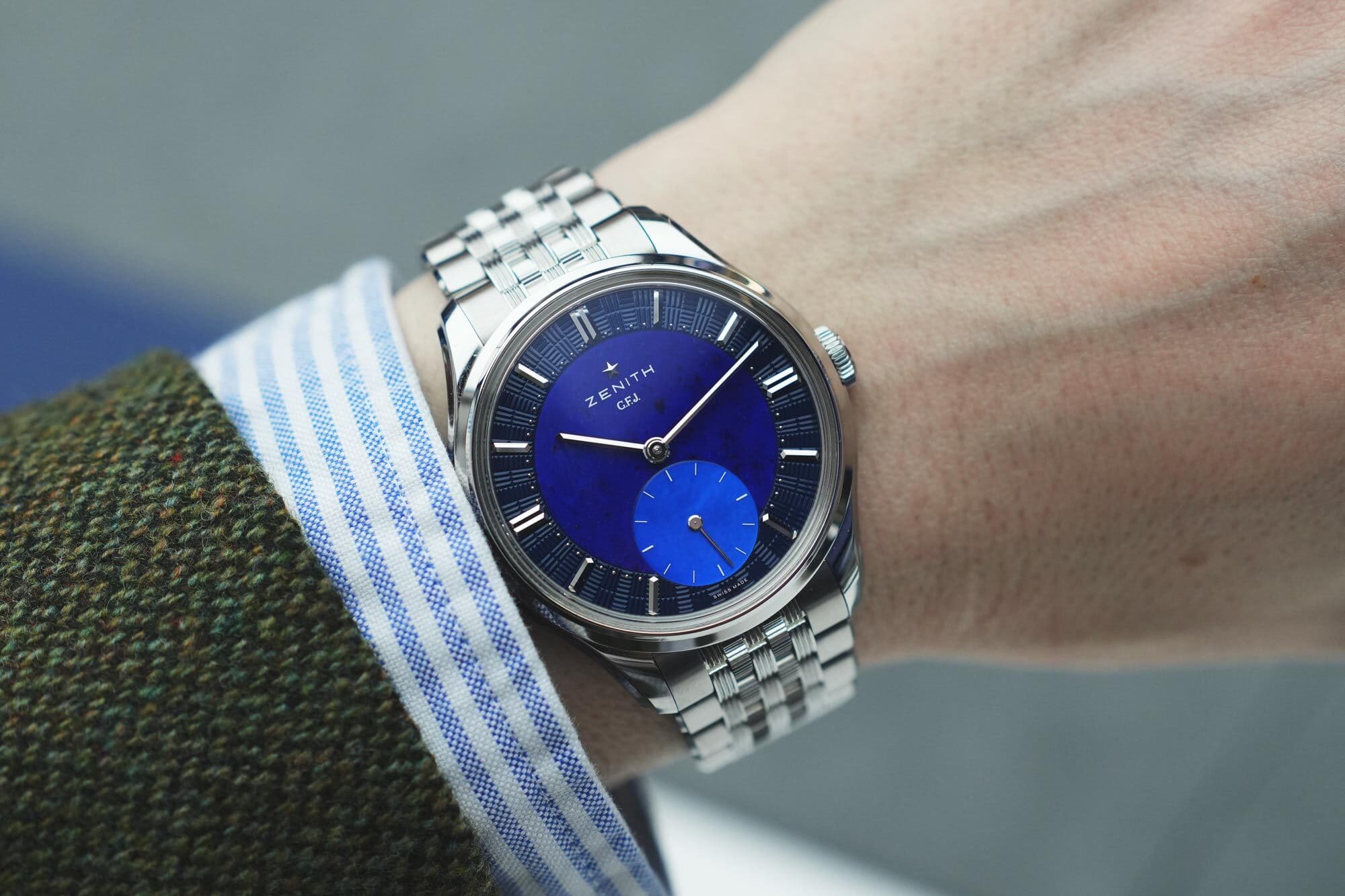
In person, it was the beautiful execution of the G.F.J.’s design that made it a highlight of Watches & Wonders for me – the movement was effectively icing on the cake. The G.F.J. extends this year’s blue theme in handsome fashion with a three part dial featuring heavy brick guilloche at the outer track, a lapis lazuli main dial, and a mother of pearl subdial at 6:00 for the subsidiary seconds. At a time when stone dials are literally everywhere, I think it’s interesting that Zenith has created something where the lapis of it all doesn’t scream out at you as a headlining feature. To put it another way, in the weeks since Watches & Wonders, I haven’t really heard anyone refer to this as Zenith’s experiment with stone dials. To me, that speaks to the cohesion of the design. They’ve found a way to make the disparate parts that make up a quite complex dial work together in a harmonious way. Every detail is deliberate, but nothing is out of place.
There’s a lot to soak in with the dial, but I think my favorite little details are those little minute markers, tiny balls of solid white gold, between each hour marker (also in white gold). This would have been an easy place for Zenith to take a shortcut – I can imagine another brand, or even Zenith in a different context, rhodium plating those minute markers. But the G.F.J., among other things, is an exercise in opulence through craft. There are no obvious shortcuts here, and that’s one of the most satisfying things about the G.F.J. I’ve been critical of watches that come from big luxury groups lately for taking the easy road, commoditizing craft and luxury, and sometimes not taking their customers seriously. But with this release, Zenith has the pedal pushed all the way to the mat, and it feels like the brand is operating with a “spare no expense” mindset. To see the results of an effort like that in a simple three hand dress watch is quite extraordinary, and recalls some of the best watches to come out of the independent space over the last few years. It’s been repeated frequently across watch media that the output of even the most powerful and influential indie brands is a tiny fraction of what’s represented by the big players, and that we shouldn’t expect the likes of F.P. Journe, Berneron, and others to influence conglomerate owned brands, but this watch definitely seems to be in conversation with some of the most notable indie releases of late. If that’s a trend that continues – big brands taking their cues at the very high end from the small – things could get really interesting.

The G.F.J.’s case is solid platinum, and measures just a hair over 39mm in diameter and 10.5mm tall. The stepped lugs curve gently downward and the watch measures 45.75mm from end to end, for a compact look on the wrist that still has plenty of heft thanks to the solid platinum case. Case finishing is very nice, with alternating brushed and polished surfaces. And it’s platinum, so of course it has a brightness and luster to it that is pretty addictive. In our meeting with Zenith at Watches & Wonders, a veritable commotion was caused when the solid platinum bracelet was unveiled. Available for an additional $50,000, the seven-link G.F.J. bracelet is among the most impressive things I saw all week. Knowing even a little bit about the difficulties in machining and finishing platinum will immediately make the price make a bit more sense. Again, the level of detail and consideration here is impressive, with the brick motif carried over on the interior links and meticulous finishing applied to all sides of each link. The phrase “over the top” comes to mind when thinking about the bracelet execution here.
Thinking about the watches I saw at Watches & Wonders this year, there are few that have me thinking about the place of a brand across the wider watch world as much as the G.F.J. As I mentioned above, the watch impressed me in a way not dissimilar to the way many indies have made an impression on me recently, and it will be interesting to see if Zenith continues the G.F.J. project as a way to produce high end watches in (relatively) small batches, or if we’ll eventually see more consumer focused G.F.J. products in non-precious materials with less exotic finishing. It could also, of course, be a platform to push Zenith chronometry forward in a way that’s somewhat set apart from the Elite and El Primero calibers. Time, of course, will tell. For now, it’s nice to enjoy one of the genuine surprises of Watches & Wonders 2025. Zenith

