When the Zenith Defy Revival diver was released last year, I somehow missed it. I didn’t see it when it passed through the office, nor at any press events, and honestly, I just didn’t take notice of articles. I guess I was busy. While unfortunate in one sense, perhaps it was for the best, as my first in-person experience with it was with its follow-up model, the Zenith Defy Revival Shadow, and I was immediately taken.
Small, dark, weird, vintage-y, and yet also with a 90s vibe, it sank its titanium teeth into me fast. I’m not surprised, to be honest, as the “shadow” watches by Zenith have been their coolest models in the last several years, at least to yours truly. An aesthetic outlier within their collection, these occasional brooding models utilize not just the best-metal-for-a-sports-watchTM, titanium, but also a unique micro-blasting, which gives them a charcoal tone that is more nuanced than black coatings. Light and dark in one package, I’m surprised I don’t already have a Shadow in my watch box.
The Shadow Treatment
But, even among the Shadow models, the Defy Revival stands out. It’s a remarkably compact, tough tool watch with unique vintage styling that comes to life with shocks of neon yellow. The only shadow model to use a color, Zenith wasn’t shy, and it paid off. A love it or leave it hue, it was a risk. This is the kind of unexpected design choice that will make me take notice of a brand. To use an expression I truly hate, “I see you,” Zenith (yuck).
Advertisement
$8200
Defying Expectations: Hands-On with the Zenith Defy Revival Shadow Diver
Case
Titanium
Movement
Zenith Elite 670
Dial
Black and Yellow
Lume
Yes
Lens
Sapphire
Strap
Titanium Bracelet
Water Resistance
600m
Dimensions
37.4x44mm
Thickness
15.5mm
Lug Width
18mm
Crown
screw-down
Warranty
Yes
Price
$8200
Design
“Brutalism” has become the new “minimalism” in the last year or so, which is to say, an over and often incorrectly used expression (and that was before the movie). But, at the risk of hopping on this cliché train, the case of the Defy Revival Shadow is beautifully brutal. Whether this was the intention in 1969, when the original was designed, is unclear, but the modern incarnation in micro-blasted titanium is brutal through and through. It’s blocky, faceted, and imposing, though small, and thanks to the gorgeous surface finish, it’s dark and drab. As concrete is often the material of choice in brutalist structures, but impractical for watches, titanium achieves a close enough likeness.
Brutally Yours
Hard lines, good times
The bezel is thin, but grippy
The Elite 670 automatic
Lugless and measuring 37.4mm x 44mm x 15.5mm to the top of a thick, domed sapphire crystal, the octagonal case is appealingly dense. It’s physically relatively small, yet has a sense of mass and material presence that belies its size. 15.5mm is relatively large in proportion to the other measurements, yet it appears appropriate. The side profile is well broken up with a fairly thin mid-case, effectively hiding the height of the case back and bezel/crystal assembly. That’s not to say it isn’t chunky, but it’s pleasantly so. It’s worth keeping in mind that it has 600m of water resistance, so it needs to have some meat on its bones.
The 120-click bezel features wide, easy-to-grip teeth and a thin insert. An unusual aspect of the original design, the skinny dive bezel, perhaps the thinnest I’ve encountered of its kind, allows for a comparatively large dial opening, which in turn helps prevent the watch from appearing too small. The insert, which consists of a print under a sapphire crystal, is rendered in a piercing yellow with a slight acid green tinge. Mountain Dew, tennis ball, highlighter – you take your pick. This yellow is similar in intensity, and it’s gorgeous. The insert might be thin, but it packs more than enough punch to make up for it.
A matching date would have been perfect
The toxic waste yellow (unofficial title) continues to the minute index of the dial. This has the effect, if minimally, of making the bezel appear wider, though there is a noticeable gap between the two, courtesy of a secondary fixed bezel with 14 sides. This is an unusual detail, as the bezels of most divers typically come flush with the crystal. However, it is also seen on other 1970s-era divers, such as the Squale 2002. In that instance, however, a locking mechanism is in place that requires the bezel to be pushed down before turning. That aside, back to the “b” word, it adds to the brutal charm of the case.
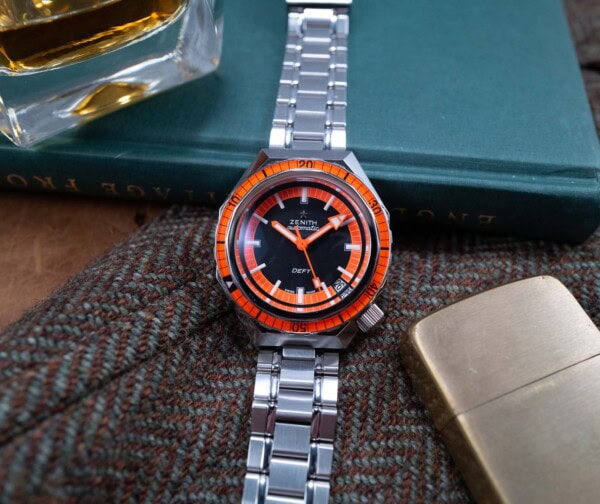
The dial is quite tame in comparison, save the broad ring of yellow. The center of the surface is matte black, and lumed markers sit at each hour, crossing the regions. The markers at 3, 6, 9, and 12 are larger and have an additional outline. The hands are also yellow for a final zing of color. It’s a straightforward design that, although period correct, could have been designed in 2025. Clean and legible, but bold where needed. That said, it doesn’t have a particularly high-end look either, which, given the price point, may irk some folks. It’s a tricky situation, as it feels like the correct dial given that this is a tool watch (and it’s pulled from the original), yet it’s no different from what one might find on a sub-$1,000 diver. One last thing, given the modern material updates to the case, I wish they had color matched the date to the yellow.
The Defy Revival Shadow comes mounted on a titanium bracelet with a matching finish. It’s 18mm at the lug and 16.25mm before the clasp. It’s a cool five-link design with three flat links and two “beads of rice,” though I wouldn’t call it a “beads of rice” style bracelet. Regardless, it’s just different enough from typical bracelets to be interesting, and it looks incredible with the micro-blast finish. The links are also easily adjusted with single-sided screws. The clasp is a typical locking foldover with no on-the-fly micro-adjust, but several spots for fixed micro-adjust that allow for finding a good fit. There is also a dive extension built in. It’s appealingly compact, all in all, and the locking flap is entirely flush when closed for a sleek finish.
A radical design like the Defy’s can sometimes look great on paper or your desk, but not be as successful on the wrist. Luckily, that is not the situation. Actually, quite the opposite, in fact. It’s fantastic on the wrist, with dimensions that simultaneously keep it well-positioned and an aggressive design that lends it considerable presence. Even the thickness feels right as it’s pleasantly chunky and solid, reinforcing that it’s a rugged little watch, yet not a slab. Thanks to the titanium, sized for my wrist, the weight was 95 grams, which is relatively light, and logically around 33% less than the steel version. This lends to even greater comfort, and one could swap on a tropic-style rubber strap for even more weight reduction while still looking good. Lastly, the crown position prevents any possible irritation.
A gorgeous bracelet
Aesthetically, it may not appeal to everyone, but I found it incredibly charming. The dark metal, which has a hint of warmth to it, as titanium often can, looks amazing and genuinely different from other case materials. Gunmetal coatings usually have a subtle sheen, and other matte-finished titaniums are generally brighter. Moreover, it’s just great to have an option that’s dark but not all black, as PVD/DLC black watches, while they have an appeal, can be too intense as well. Furthermore, the fact that it’s a few shades lighter than black allows the neon yellow accents to pop without being obnoxious. They are bright, for sure, but within reason. One last positive aspect of the matte finish is that it doesn’t pick up fingerprints. As someone who finds themselves constantly cleaning polished surfaces (as well as their glasses), this is a relief.
Powering the Defy Revival Shadow is the Zenith Elite 670 caliber. An in-house movement that was debuted in 1994, the 670 is an automatic with 27-jewels, a 50-hour power reserve, date, hacking, and a frequency of 28,800 bph. Zenith calls it a thin caliber, and from what I’ve found, it’s likely around 3.4mm thick. Visible through the case back, the 670 is decorated with circular Côte de Genève, tiny perlage circles, and a partially skeletonized rotor. It’s a nice enough-looking movement, if clearly a workhorse. That said, this is an instance where I don’t think seeing the movement was necessary, especially given the watch’s close replication of the original, which was solid.
A nice enough looking movement, but should we see it at all?
Conclusion
We might have hit peak dive watch in 1969, when the Defy Revival (ref. A3648) first debuted. It’s compact, unique, stylish, rugged, and highly water-resistant. Sure, the octagonal shape might not be for everyone, but sometimes it feels like we’ve gone backwards, or at least nowhere, since. Brands try to convince us that we need to wear hockey pucks to get high water resistance, and designs are rarely out of the box. Gripes on the state of dive watches aside, it was smart of Zenith to bring this model back, as it’s easy to think of them as just the El Primero, while this proves they make a great diver too.
37.4mm on a 6.75″ wrist
With that being said, while the steel model is cool, the Shadow is brilliant. It keeps the vintage charm of the quirky 37mm, 600m case, while being thoroughly modern. Actually, other than the fact that the design replicates one from 1969, nothing is vintage-feeling about it. In a world where luxury brand dive watches feel designed for a bland, risk-averse customer base, which is to say, not the enthusiast, the Defy Revival Shadow is a breath of fresh, if moody, air.
But, there is a catch. As expected from a luxury brand watch, it comes with a luxury price tag. At $8,200, the Defy is a fair chunk of change. How much of this comes from the branding, or the movement, is anyone’s guess, and it’s frankly not a surprising price either, but I can’t help but feel like it’s holding the watch back from real stardom. Obviously, the name/brand couldn’t change (nor would we want it to), but as the Elite 670 isn’t chronometer-rated, doesn’t have a particularly long power reserve, doesn’t have a silicon escapement or other modern upgrades, nor is it hi-beat, Zenith’s signature, it doesn’t add anything except “in-house” cred. Had this watch featured an ETA 2892/Selitta SW300 chronometer and been in the $3,000-$5,000 range, I think many of us (myself included) would have a new diver in our collection. Zenith
Zach is the Co-Founder and Executive Editor of Worn & Wound. Before diving headfirst into the world of watches, he spent his days as a product and graphic designer. Zach views watches as the perfect synergy of 2D and 3D design: the place where form, function, fashion and mechanical wonderment come together.
This website uses cookies to improve your experience while you navigate through the website. Out of these cookies, the cookies that are categorized as necessary are stored on your browser as they are essential for the working of basic functionalities of the website. We also use third-party cookies that help us analyze and understand how you use this website. These cookies will be stored in your browser only with your consent. You also have the option to opt-out of these cookies. But opting out of some of these cookies may have an effect on your browsing experience.
Necessary cookies are absolutely essential for the website to function properly. These cookies ensure basic functionalities and security features of the website, anonymously.
Cookie
Duration
Description
cookielawinfo-checkbox-analytics
11 months
This cookie is set by GDPR Cookie Consent plugin. The cookie is used to store the user consent for the cookies in the category "Analytics".
cookielawinfo-checkbox-functional
11 months
The cookie is set by GDPR cookie consent to record the user consent for the cookies in the category "Functional".
cookielawinfo-checkbox-necessary
11 months
This cookie is set by GDPR Cookie Consent plugin. The cookies is used to store the user consent for the cookies in the category "Necessary".
cookielawinfo-checkbox-others
11 months
This cookie is set by GDPR Cookie Consent plugin. The cookie is used to store the user consent for the cookies in the category "Other.
cookielawinfo-checkbox-performance
11 months
This cookie is set by GDPR Cookie Consent plugin. The cookie is used to store the user consent for the cookies in the category "Performance".
viewed_cookie_policy
11 months
The cookie is set by the GDPR Cookie Consent plugin and is used to store whether or not user has consented to the use of cookies. It does not store any personal data.
Functional cookies help to perform certain functionalities like sharing the content of the website on social media platforms, collect feedbacks, and other third-party features.
Performance cookies are used to understand and analyze the key performance indexes of the website which helps in delivering a better user experience for the visitors.
Analytical cookies are used to understand how visitors interact with the website. These cookies help provide information on metrics the number of visitors, bounce rate, traffic source, etc.
Advertisement cookies are used to provide visitors with relevant ads and marketing campaigns. These cookies track visitors across websites and collect information to provide customized ads.


 Latest Review