


 Latest Review





To pursue the level of watchmaking American independent brand J.N. Shapiro has, you need more than a bit of talent and a dash of ambition. Even if you manage to master the skills required to craft the impressively detailed Neo-traditional watches J.N. Shapiro makes, having a unique enough take on a traditional aesthetic and the business savvy to compete on the world’s stage of independent watchmaking is another story altogether. It demands a near-monastic lifestyle to pull off.
J.N. Shapiro’s founder and visionary, Josh Shapiro, hasn’t just answered the call – he’s actually making it work.
More remarkable still, Shapiro produces his premier line of watches, the Resurgence, entirely in the United States and almost entirely in-house. Notably, “in-house” is used in the literal sense here, meaning under one roof – a very different thing from what that term has come to mean as a shadowy marketing tool that tends to gloss over some subcontracting and outside manufacturing. Every component in the Resurgence, save for jewels and springs, is entirely produced and finished by Shapiro and his team in California.

While a watch of the Resurgence’s caliber being produced both in-house and domestically is as impressive as it is unexpected, there’s more at play here than just an inflated sense of national pride. Bootstrapping high-level American watchmaking and parts manufacturing certainly benefits Shapiro’s operation first and foremost, but it’s also part of a larger, somewhat benevolent mission to reinvigorate the long dormant American watch manufacturing machine.
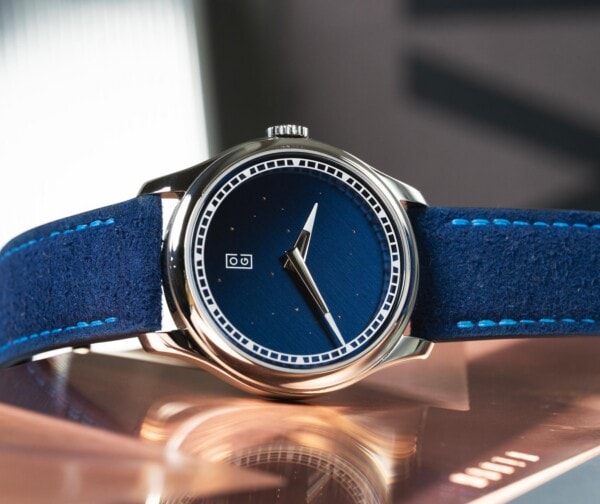
As a watchmaker, Shapiro’s calling card is his dial work. Prior to launching his own line, Shapiro made traditional engine-turned dials for other notable manufacturers, and his mastery of that craft puts him in arguably a category of his own. The signature multi-layer “infinity weave” guilloché dials found in Shapiro’s watches are a show-stopping affair that he describes as “a treat for macro photography” and while Shapiro’s watches throw a subtle twist on every facet of neo-traditional watch design, his guilloché dials are what truly elevate his watches to the realm of something special – even amongst his high-profile peers in the Daniels watchmaking lineage.
Shapiro’s latest release sees the brand returning to its more accessible roots by bringing back a refreshed take on their Infinity Series, which give enthusiasts an opportunity to enjoy his otherworldly dials at a far more attainable price point than the firmly upscale Resurgence. With the Infinity Series Pure, Shapiro presents a streamlined take on what his brand does, complete with his hallmark dials and sculpted, three-dimensional handset, at a price that may still drop the jaw of the uninitiated, but places it legitimately in the entry level tier for an independent with Shapiro’s prestige. It’s the J.N. Shapiro experience in its purest form.
As the freshly unveiled Infinity Series Pure began making its rounds, Worn & Wound caught up with Josh Shapiro. The watchmaker brought us inside the return to his brand’s entry level watch, his philosophy as a watchmaker, his brand’s unique position as America’s independent, and how one goes about mastering what are essentially the dead languages of horology.

What does it mean for you as a watchmaker and an enthusiast to represent the US on the grand stage of independent watchmaking, and what are some of the unseen challenges that go into producing a watch like the Resurgence almost entirely in-house, and entirely in the US?
Josh Shapiro: Those are two very deep questions. When I first launched my brand, there was a tremendous amount of competition in the $5-10k range of watches, and that’s where I was initially thinking I’d try to target. My mentor, David Walter, made clocks that were hundreds of thousands of dollars, and his advice was really pivotal for me.
He said “If you do something really special, not only can you pay yourself a living wage, but you’ll be able to go a lot deeper into your craft.” So for our first watch, the Infinity Series, I put a tremendous amount of effort into making something I felt was truly special, and that was particularly focused around the dial. Because I charged more for that watch, I was allowed to explore some extremely intricate techniques, like our infinity weave and our meteorite guilloché dials. Having a higher price point gave me this freedom to go deeper and that tied into this idea that I didn’t want my clients to feel like there was any tangible quality difference simply because I’m making watches in America, which wasn’t known for this quality of watches.
Our mission statement says we want to “deliver work on-par or exceeding the highest level of our peers, and that we want to be amongst the highest quality watches in the world.” I mean that and it’s very important to us. My clients know when they’re buying a Shapiro that they’re buying a piece of artwork that’s produced at an extremely high level, regardless of where it was made. The Resurgence watches represent many things for me, but they embody the philosophy of extremely high-level, world class watchmaking first.

What prompted the return to a more attainable category with the Infinity Series Pure? Do you feel as though you’ve accomplished that original mission with the Resurgence watches in a way?
Yeah, in a sense, but bringing back an entry level watch was more about giving the people what they want. To do everything we wanted to do with the Resurgence line, we had to charge a lot of money. There was just no way to make that watch any more affordable and honestly, we don’t charge enough for those. Not by far. Watchmaking in a vacuum is exceptionally difficult and it’s why we don’t see giant American mechanical watch brands.
We’re severely lacking in people here. Even Switzerland is understaffed in the watchmaking space right now – which is why they have to go to China for so many of their parts. Japan and China have huge watch labor forces. Germany relies on Switzerland, but in the United States, we have very few people in the profession and most of the watchmakers in the United States are employed in service, which is a very different skill from watch manufacturing. So that makes what we do a massive challenge just from a basic manufacturing infrastructure stand point.
It’s a small world of independents and we don’t really feel the heat in terms of competition. Most watch collectors that love independent watchmakers collect all of our watches.
We also make all the small parts that people don’t notice inside the watch. The pins, the winding pinion setting, the pinion balance, staff balance, the wheel-setting mechanism – all these small parts that go unnoticed in a movement because they aren’t beautiful bridges and plates that you see the second you open a caseback. These unnoticed parts are the most challenging to make and haven’t been made in this country in 70 years, so we’re having to relearn all the secrets and techniques and metallurgy behind making these tiny parts. The Infinity Series Pure is really a return to a very pure expression of what we do. We’re outsourcing the movement for these so the watch’s big focus can be the dial, which is really my calling card.

What’s the benefit of making a part that’s buried in the movement in-house? Is there a tangible quality differential in how that movement performs?
Well, one thing is that when most brands say “in-house,” it’s just a marketing term. They usually mean it’s a proprietary movement and they send it out to a million different subcontractors. I was always really inspired by George Daniels and Roger Smith, who really do everything under one roof. To make something truly in-house was always my dream and was always my goal. I was inspired by the challenge of doing that. So that’s one aspect of it.
The other aspect is that, in order to kickstart American watchmaking, we had to bite the bullet and do all of the hard things. People in this country have made main plates and bridges before, but no one has gone back to do what Hamilton and Waltham and Elgin were doing – which is making virtually everything in a watch. There’s only one way to kickstart that kind of manufacturing revolution and that’s just to do it. And yes, there’s a pragmatic element here in that we have ultimate quality control. We’re not waiting on suppliers or relying on them for that. If there’s an issue with a part or we discover a better way of doing things, we can implement it immediately.