Usually when watchmakers brag about space cred, they bring up models that have gone to space or that are made of rocks from space or that take inspiration from the solar system. Zach Smith has them all beat: the Ohio-based horological craftsman makes aerospace engineering components (among other things) at his workshop, Hour Precision. Smith had hoped from the start that Hour Precision would make watches, and found along the way the machines and expertise you need to machine intricate watch movement pieces translate well to making parts for semiconductors, medical equipment, and, of course, aerospace components.
That move into non-horological industries came relatively recently for Smith, however. Before the micro-machining and before he founded Hour Precision, Smith was a high-school-aged watch enthusiast who landed a job in a jewelry school.
“I was fixing heart rate monitor watches. There was a brand called Polar before the Apple Watch that made fitness watches, and I started off doing that and then moved,” said Smith. “My boss at the time was selling pre-owned Rolex. He would buy product from walk-ins and from other suppliers and refurbish the Rolex watches, polish them, etc., and then sell them. After a while where I was doing well with the Polar watches, he asked me if I wanted to start doing that.”
Zach Smith, front left, upon graduation from watchmaking school. Image courtesy Zach Smith @zachsmiami
Advertisement
From there, Smith moved to another store that processed between 300 and 500 pre-owned Rolexes per month, and worked on a team of six watchmakers overseen by a Rolex-certified watchmaker. After a few years on the job, Smith’s boss asked him if he’d like to take his training a step further and become a certified watchmaker. From there he went to the Nicolas G. Hayek Watchmaking School, then to Omega after graduation, then Smith started out on his own as a high-end watch repairer. While repairing watches, Smith started to think about the parts he was replacing in movements, often the costliest part of a repair.
“The challenge, as everyone knows, is getting parts and even having the certifications,” said Smith. “Rolex does not want to give anyone a parts account unless you’re an AD also. Omega was willing to do it, but I could basically send the watch to them for cheaper than I could do it buying parts from them.”
An idea started to form in his brain: Why couldn’t he make his own watch parts? How hard could it be?
“I figured out it was really hard,” said Smith. “Watchmaking school really teaches you how to be a parts changer. They’re not teaching you how to make parts or fit components together.”
He had some experience machining from messing around with a computer numerical control machine in his parents’ garage growing up and having restored a desktop CNC machine, but it took an intense process of trial and error to learn how to make the intricate parts necessary for a watch movement. And once Smith had the skill to do so, he started to pivot away from watch-repair to micro-machining. But his big break didn’t come until he bought a broken CNC machine in 2021.
CNC machines at Hour Precision. Image courtesy Zach Smith
“My first really good CNC machine was one that was broken, and I got it because KERN Precision Inc. told me about it. I flew out to Silicon Valley, picked up the machine and fixed it when I got back to Ohio. They were really impressed by it, I think,” said Smith. Three months later, KERN offered Smith another broken CNC machine, which he bought and once again fixed. Shortly after, they offered him a job as a contractor.
Through KERN, Smith met a network of companies that needed micro-machining, and quickly his personal client list began to grow. Then, something interesting happened: watchmaking started making a resurgence in the United States and Smith found his new skillset in demand in the industry that had been his first professional love.
A mainplate fabricated at Hour Precision. Image courtesy Zach Smith
“Three years ago, there were fewer people who knew that it was a possibility to even make a watch here,” said Smith. But since then, Hour Precision has created an entirely in-house movement for Alex Voss, designed the dual-time complication in Typsim’s TimeTraveler, and is partnering with the Cornell Watch Co. to manufacture the latest Cornell watch. More projects for brands are in the works, but NDAs prevent Smith from discussing them at this point in time.
Smith is excited to have returned to the world of watches, and has thrown himself into the work. As the sole machinist at Hour Precision, Smith’s work days often go until well after midnight, even with the assistance of automation where possible.
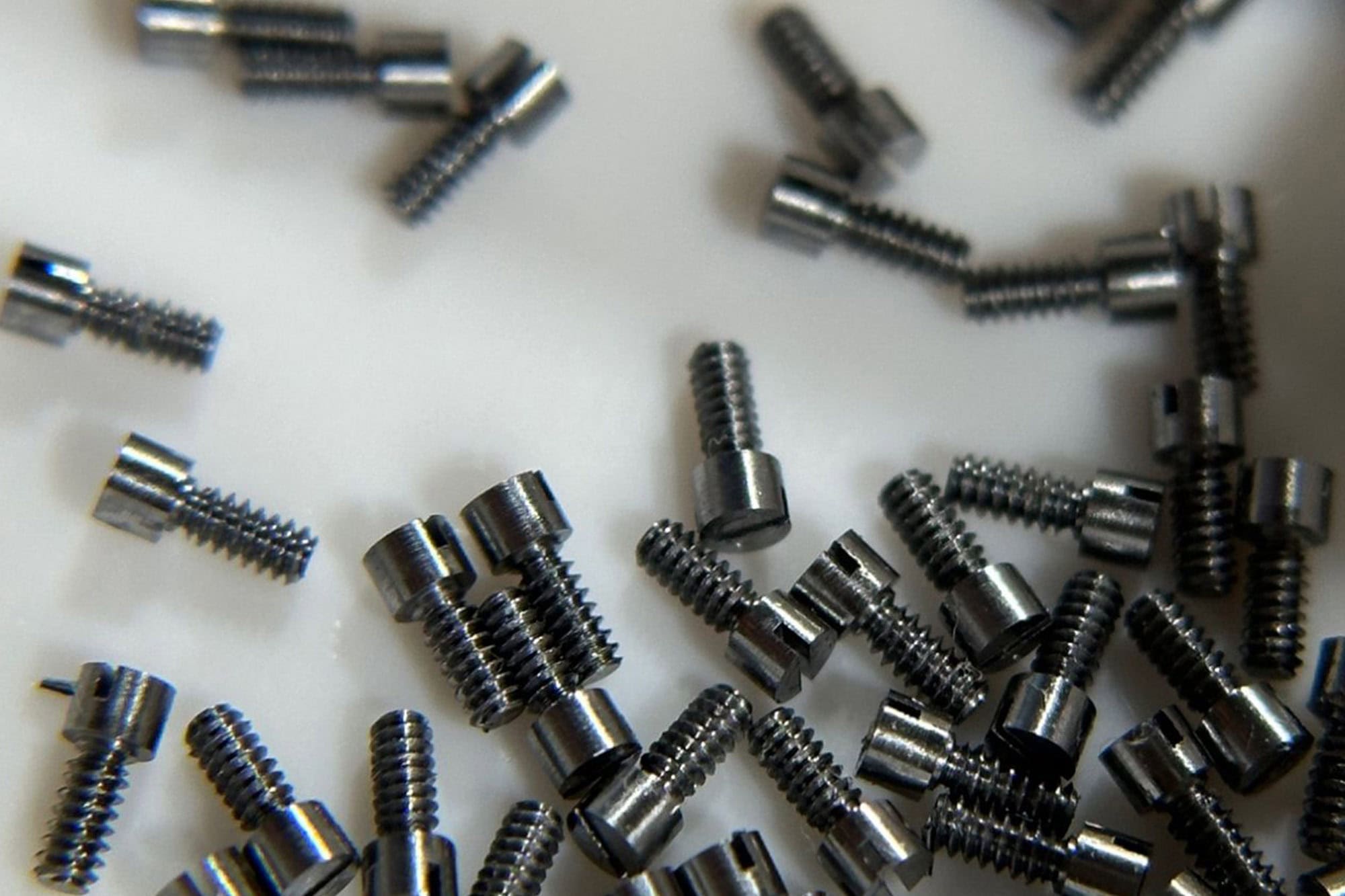
High precision micro screws that can be fabricated to varying lengths in different materials based on the needs of the client. Image courtesy Zach Smith
“It’s very much a machine shop environment here,” said Smith. “When something is stable, I can automate the process. Assembly, I’m doing myself.”
For now, Smith is making parts and movements for other brands, but he says “there’s something that’s going to come eventually from my shop that’ll be made here, a Zach Smith watch.”
Alec is a writer and editor based out of Washington, DC, currently working as a congressional reporter. His love for wristwatches started at age 10 when he received a Timex Expedition as a birthday present. A film buff and tennis fan, Cary Grant and Roger Federer played influential roles in continuing to develop his interest and taste in watches.
This website uses cookies to improve your experience while you navigate through the website. Out of these cookies, the cookies that are categorized as necessary are stored on your browser as they are essential for the working of basic functionalities of the website. We also use third-party cookies that help us analyze and understand how you use this website. These cookies will be stored in your browser only with your consent. You also have the option to opt-out of these cookies. But opting out of some of these cookies may have an effect on your browsing experience.
Necessary cookies are absolutely essential for the website to function properly. These cookies ensure basic functionalities and security features of the website, anonymously.
Cookie
Duration
Description
cookielawinfo-checkbox-analytics
11 months
This cookie is set by GDPR Cookie Consent plugin. The cookie is used to store the user consent for the cookies in the category "Analytics".
cookielawinfo-checkbox-functional
11 months
The cookie is set by GDPR cookie consent to record the user consent for the cookies in the category "Functional".
cookielawinfo-checkbox-necessary
11 months
This cookie is set by GDPR Cookie Consent plugin. The cookies is used to store the user consent for the cookies in the category "Necessary".
cookielawinfo-checkbox-others
11 months
This cookie is set by GDPR Cookie Consent plugin. The cookie is used to store the user consent for the cookies in the category "Other.
cookielawinfo-checkbox-performance
11 months
This cookie is set by GDPR Cookie Consent plugin. The cookie is used to store the user consent for the cookies in the category "Performance".
viewed_cookie_policy
11 months
The cookie is set by the GDPR Cookie Consent plugin and is used to store whether or not user has consented to the use of cookies. It does not store any personal data.
Functional cookies help to perform certain functionalities like sharing the content of the website on social media platforms, collect feedbacks, and other third-party features.
Performance cookies are used to understand and analyze the key performance indexes of the website which helps in delivering a better user experience for the visitors.
Analytical cookies are used to understand how visitors interact with the website. These cookies help provide information on metrics the number of visitors, bounce rate, traffic source, etc.
Advertisement cookies are used to provide visitors with relevant ads and marketing campaigns. These cookies track visitors across websites and collect information to provide customized ads.

 Latest Review