

Christopher Ward Gets Ready for the Summer with the C60 Trident Reef

2025 has already been a memorable year for Christopher Ward. Having launched the C12 Loco back in April, their most ambitious watch to date, they’ve further shown they are an indie force to be reckoned with. But, while the C12 Loco proved that they can achieve complicated watchmaking at a reasonable price, it was still on the top end of their catalog. To balance this, for their next launch, they are returning, to some extent, to their roots with an affordable diver, the C60 Trident Reef.

Please note that production watches will differ from the samples shown in the following ways: the depth rating will match the color of the “automatic” text, and the hour hand will be rhodium plated.

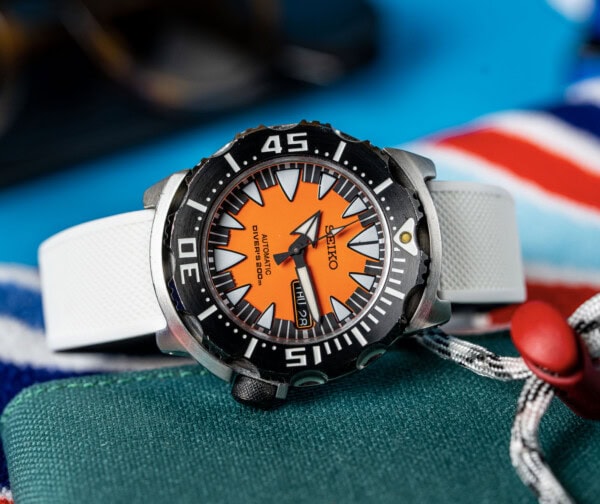
A playful riff on the Trident C60 platform, the Reefs are modern, colorful, and feel like a throwback to watches from about a decade ago, rather than something mid-century. Coming in five colors and two sizes, they feature a new case with a shrouded mid-section, allowing for a dynamic design, especially at the price. Wrapped in matte aluminum (save one version), the mid-cases are anodized to match the aluminum bezel inserts. The result is fun and unexpected, if intense, particularly on a model like the orange shown.

Advertisement

Measuring either 41 x 47.9 x 11.45mm or 44 x 51.4 x 11.45mm, both models feature 22mm lugs and 200m of water resistance, positioning them as medium and large divers in the C Ward collection, which fills gaps left by the C60 Pros. The 44mm model, in particular, will be met with excitement as C Ward, like most brands in the last several years, has focused on 38-40mm cases for their divers. Though that smaller range is to my preference, large-wristed individuals and those who like a larger watch have had fewer releases.

The new four-part light-catcher case drops some of the finishing found on the solid steel models, but gains the shrouded mid-section, which opens up numerous opportunities. The white dial, for example, uses ceramic instead of aluminum, which lends it a higher-end feel. Other obvious possibilities include different finishes and textures, such as knurling. The contrast between the steel lugs and crown guards also has an appealing effect.

The Trident lineage is clear in the dial of the Reef, though it takes on a bolder, perhaps even sportier demeanor. The large, metal rectangular applied markers with lume fill appear the same as on other models, as do the logo, flavor text, and hand shapes. The difference is in the rather large and assertive chapter ring. The ring features a unique shape, with cutouts for the applied markers, which always imbues a modern feel, and a curious lip. Where the ring meets the dial surface, the edge of the ring has been depressed, creating a clear line, and features extra flanges at either side of each applied marker. It makes for a lot of little things happening in a small space, a departure from the clean style of the Pro 300s.

Increasing the boldness, the rings are bright white (as shown in the samples), contrasting with the colorful surfaces below. Additionally, the minutes/seconds index is printed on the ring in black. Whether this ring was a necessary element is a matter of taste, but as an element to differentiate the Reefs from other C60s, it is effective. Finally, the anodized aluminum bezel inserts utilize the same typeface as the Pro model, with numerals at intervals of ten alternating with white lines. A triangle sits at the origin point, and a white ring with negative spaces further highlights the five-minute markers. Keeping with the theme, it’s a variant of the C60 Pro that doesn’t deviate too much. That said, it’s essentially the same layout as the Lumière, just in different materials.

On the wrist, the Reefs are appealingly flat and wear well. I was surprised by the 44mm in particular, as it didn’t wear as large as I thought it would. The design is aggressive, yet in a fun way that I could only describe as “beachy.” Unlike the Pro 300 models, which have a gentleman’s sports watch vibe, these feel like they were intended for the summer and water.

Maybe it’s just because they sent us the all-orange model, but something about these makes me think of dive watches from the earlier days of W&W, as mentioned earlier, back when the Seiko Monster was so popular among enthusiasts. It was a time when dive watches looked, well, fun, and were less held to a lens informed by vintage references. Also, anodized aluminum. Lots of anodized aluminum.

Powering the Reefs are Sellita SW200-1s, which are visible through display casebacks and feature decorated rotors. They are available on “Aquaflex” rubber straps for $850 and three-link steel bracelets for $1,035. Overall, the C60 Trident Reef models are a nice variant of their tried-and-true diver platform. They aren’t breaking the mould, but they also are more exciting than just new colors of the same thing. The case construction, in particular, stands out. 

As a new entry model into the line, they bring an energy that was perhaps fading. With that said, at the time of writing this, a Pro 300 on rubber is $910, and on a bracelet is $1,095, so the Reefs aren’t exactly a dramatic reduction. Actually, I have a feeling they are more of a sign that the Pro 300s are going to move up a bit to widen that gap. That’s not to say they are unfairly priced, as they are reasonable, but they don’t exactly open up a new market either. Christopher Ward

Images from this post:
Zach is the Co-Founder and Executive Editor of Worn & Wound. Before diving headfirst into the world of watches, he spent his days as a product and graphic designer. Zach views watches as the perfect synergy of 2D and 3D design: the place where form, function, fashion and mechanical wonderment come together.
wornandwound zsw
Tags: