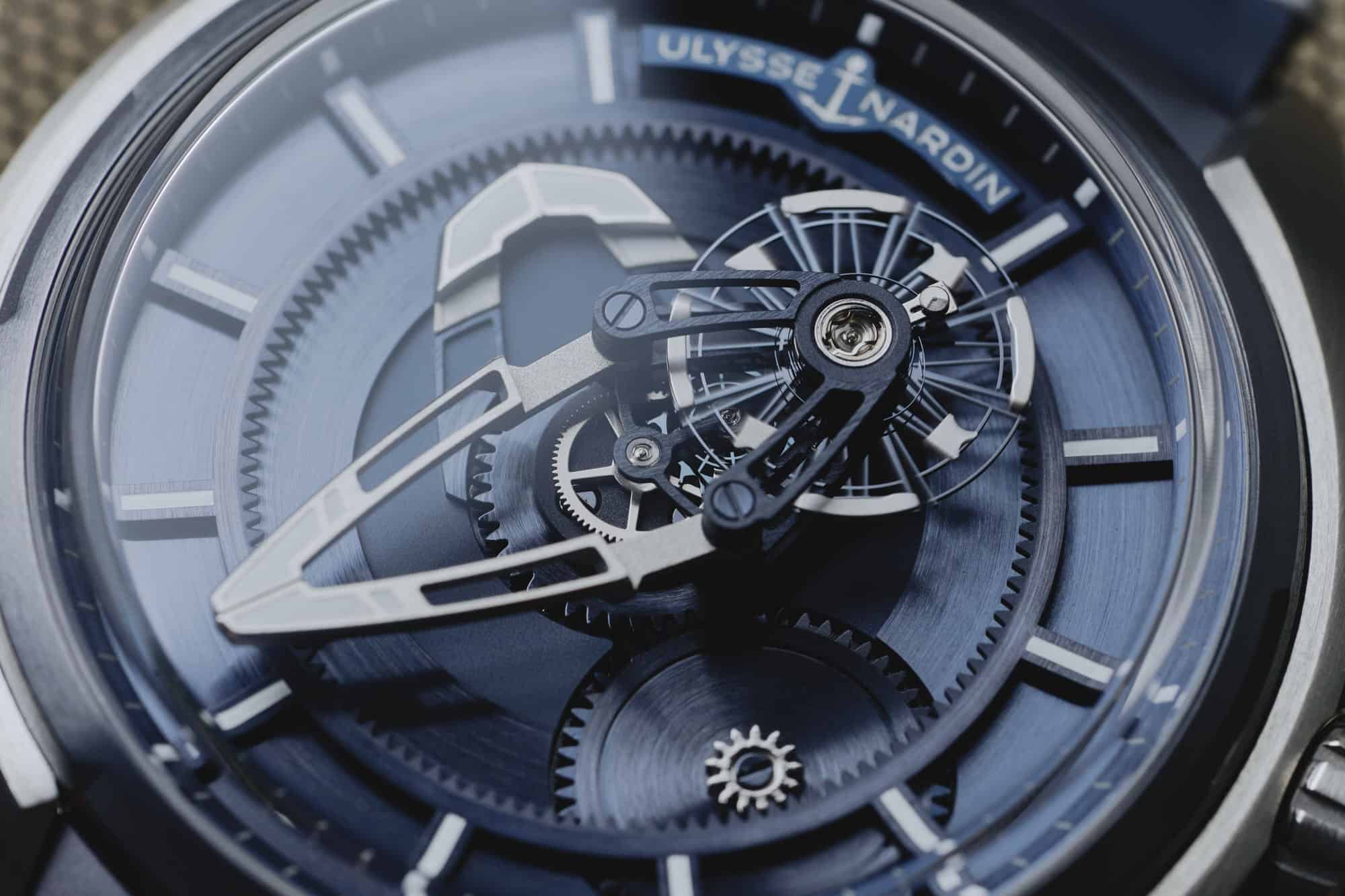
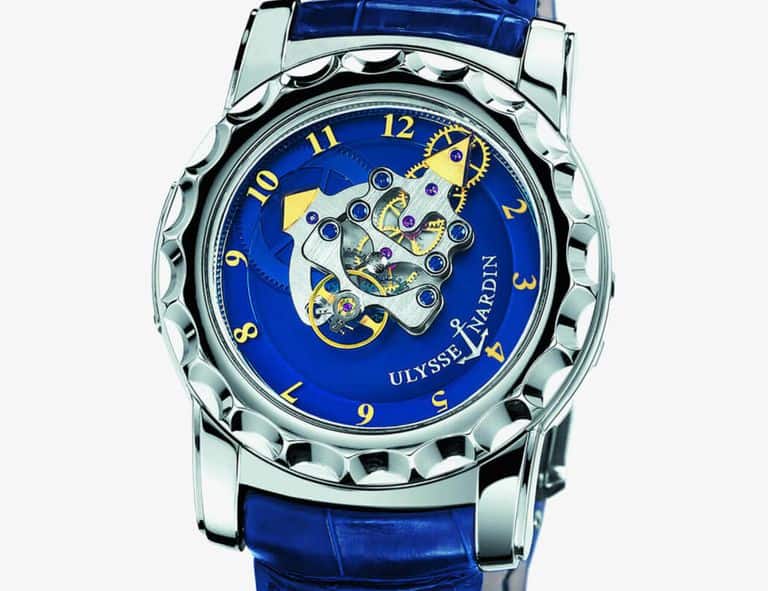
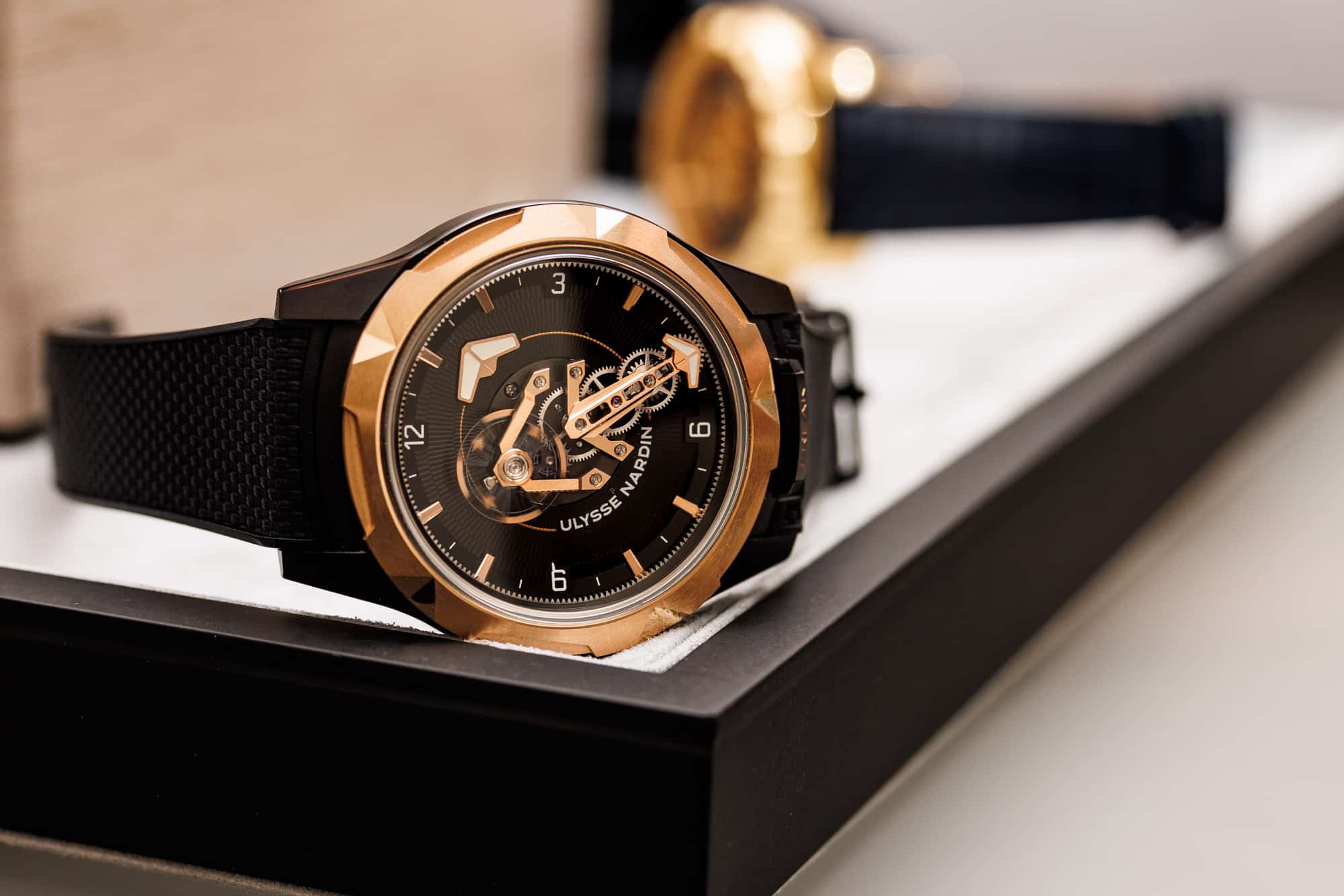
When Ulysse Nardin unveiled the Freak in 2001, it set off a chain of events that forever changed the course of history for the brand and for the industry at large. The model seamlessly flexed a combination of technical and design achievements. The Freak offered material innovation that was far ahead of its time, introducing the use of silicon in the escapement wheels—a technology that is now used by almost every major watch brand from Rolex to Patek Philippe, Girard-Perregaux, Breitling, and Jaeger-LeCoultre, just to name a few. It also presented an entirely new set of aesthetic codes for watch design with an expression of time that notably lacked a traditional dial, hands, or crown. With the Freak’s overall success, it immediately established the brand as a thought leader, an innovator, and (perhaps most importantly) a rebel in an industry often paralyzed by its reverence and steadfast commitment to tradition.
In the nearly 25-years since the first Freak, we have seen Ulysse Nardin infuse this spirit in each subsequent Freak model and its catalog at large—from the Blast collection to its UFO clocks and, most recently, in its record breaking Diver [Air], the world’s lightest mechanical dive watch.
The first Freak
We all know record setting has become a bit of a thing in watchmaking. Particularly in the past decade or so, we have witnessed brands embark on the race to claim the next world record title. Since 2014, Bulgari has set a whopping ten for the ultra-thin timekeepers in its signature Octo Finissimo line. Rolex has twice set the world record for highest depth rating with its Deepsea Challenge, first in 2012 with and then outdoing itself ten years later in 2022. Vacheron Constantin now holds the titles for the most complicated pocket watch, the Berkley Grand Complication, and wristwatch, the Les Cabinotiers Solaria Ultra Grand Complication. In 2025 alone, records have been set for the most accurate wristwatch movement powered by a mainspring in Grand Seiko’s SLGB001 and SLGB003, the world’s first timepiece crafted entirely from Cermet in Parmigaini Fleurier’s iconic Tonda PF Sport collection, and, of course, Ulysse Nardin’s ultra-light diver.
However, in typical Ulysse Nardin fashion, the original goal of the project that would result in the Diver [Air] was not to create the lightest mechanical dive watch—it was simply to create the ultimate haute horlogerie sport watch. “We wanted to show the industry how we would approach the combination of sport and high horology,” clarifies Matthieu Haverlan, Managing Director of Ulysse Nardin. “And we agreed that there were three ultimate challenges. First was in fact lightness—we wanted a watch that could really be worn during play, not just when lifting the trophy. Second was robustness—we wanted a watch that could really withstand dives beyond recreational limits. And third,” he continues, “we wanted to ensure the watch still met high horology standards, combining artistry and technical principles.”
Advertisement
When it comes to that delicate dance between form and function, Ulysse Nardin is in its element. This perfect harmony between design and technical capabilities is what put the Freak on the map more than two decades ago. When conceptualizing the watch that would become the Diver [Air], the brand was faced with this push and pull between aesthetics and functionality early on. “With both lightness and high horology standards being two of our core objectives, we knew there was really just one way to achieve these together: skeletonization,” explains Haverlan. “And for that, we needed to develop an entirely new caliber,” he continues. “Next, we knew we must think about materials, and when it comes to the material that best achieves lightness and robustness, titanium was the natural answer for the movement.”
Once again, titanium brings us back to—you guessed it—the Freak. In terms of materials, the model is most often celebrated for its introduction of silicon in the movement. However, it’s also worth noting that the Freak featured a titanium construction. While titanium timepieces have been around since the 1970s, the material did not start to become widespread in watchmaking until the 21st Century—the era of the Freak. Now, titanium cases abound across collections at all price points, but creating a titanium movement is a whole different ballgame. “Making a case in titanium is easy, but making a caliber in titanium is much harder,” Haverlan confirms. “When you are dealing with very small titanium components needed for a movement, they can easily catch fire because of their high reactivity and heat generation during machining.”
In addition to silicon and titanium, Ulysse Nardin doubled down on the use of innovative and sustainable materials with the addition of Carbonium, a type of carbon fiber sourced from the remnants left from the manufacturing of foils for the IMOCA sailboats. This Carbonium is used for the bezel and combined with a material called Nylo (which comes from recycled ocean netting) for the creation of yet another material. This “Nylo foil” is even lighter and more robust than titanium and incorporated into portions of the side of the case. “Our primary goal is to create superior materials to meet our design goals,” explains Haverlan. “And at the same time, if we can be sustainable and raise awareness for causes that are important to us as a brand, like cleaning up our oceans, that’s a great bonus.”
Ulysse Nardin uses up-cycled carbon fiber from IMOCA boats in the production of the Diver Air
Being able to fully embrace the Freak mentality comes (in part) thanks to Ulysse Nardin’s independent status. In 2022, the brand was sold by its former parent company Kering (who continues to retain stake in other major fashion houses like Gucci, Saint Laurent, Bottega Veneta, Balenciaga, and Alexander McQueen). “We just want to keep making better watches,” says Haverlan, “and uphold the 179-year legacy of the brand. The best way to do this—our best chance of success—was for Ulysse Nardin to be independent. For us, being independent means the ability to have a long-term vision,” he continues. “We prioritize brand equity over short term revenue, and we are proud to set that example in the industry with what we create.”
On paper, yes, Ulysse Nardin creates some incredibly cool watches—some even record-breaking—but the really cool thing about Ulysse Nardin goes beyond the timekeepers themselves. The brand has set the bar as a thought leader in the industry, paving the way for other watchmakers to keep watchmaking fun and let their own freak flags fly.
“I have been with Ulysse Nardin for eight years,” shares Haverlan, “and when I took the role of Managing Director a year ago, I wanted to take the time to dig deeper into what this brand really stands for. I spent a lot of time talking to employees who have been with the company many years,” he continues. “I went into the archives—and here I found two tapes that really allowed the essence of the brand to sink in.”
The first needle in the haystack Haverlan unearthed was a VHS tape from when the Freak was launched in 2001. “I watched and listened,” he describes. “I was able to place myself in that moment in time and understand what the watch really meant to us as a brand and to the industry in that moment.” The second gem he uncovered was a tape of Rolf Schnyder, the man who saved Ulysse Nardin from its near demise in the 1980s and helped restore the Maison to its former glory. “When I heard the voice of Rolf Schnyder, it gave me energy,” Haverlan confesses. “As I took in his words, I understood his mindset, the potential he saw in the brand, and his passion.”
This has undoubtedly informed Haverlan’s approach to leading the brand in the 21st century. “To me, we are the oldest watchmaking startup,” he explains. “When you look back further than Schnyder to the founding family, they were visionaries and pioneers from the beginning—they were what Formula 1 is to the automotive industry or what SpaceX is in terms of space exploration. Our marine chronometers helped the world to be discovered, for British navies to become an empire. And how did we do this?” Haverlan continues. “By innovation, by pushing the bounds, by looking forward.”
At first glance, you may not consider Ulysse Nardin to be one of the leaders in the industry. Brands like the “big three” (Rolex, Audemars Piguet, and Patek Philippe) most often get the respect and recognition for paving the way thanks to their longstanding histories and time-tested designs year over year. However, if you dig a bit deeper, you will see that other brands like Ulysse Nardin are actually serving as a pervasive force, pushing the industry forward in equally important ways.
“The 15 significant innovations Ulysse Nardin brought to the development of marine chronometers was just the start,” explains Haverlan. “Then you must look to the 90s when we began advancing watch complications. Audemars Piguet just released a crown-only perpetual calendar, the Caliber 7138,” he continues. “Ulysse Nardin did this 30 years ago with our Perpetual Ludwig in 1996 and later the Maxi Marine Aqua Perpetual in the early 2000s. I am not saying this to brag,” Haverlan clarifies. “If a complication is simplified, it is better for everyone—it’s more user friendly for the wearer and it’s better for maintenance on the movement for watchmakers. But for certain, AP was inspired by Ulysse Nardin in this design.”
The Perpetual Ludwig from 1996. Image via Christie’s
One of the latest QPs from Audemars Piguet is not the only example of Ulysse Nardin’s influence on the industry. “The escapement that Rolex has just released in the Land Dweller is heavily inspired by the first direct dual escapement from the Freak in 2001,” Haverlan describes. “Of course, Rolex has improved on it and done it better, and this too is what’s best for everyone—collectors, the industry—to be inspired by the work of another and build on it.”
In addition to these examples of evolution in complications and materials, Ulysse Nardin has taken things a step further in its contributions to the industry. In 2006, the Maison co-founded a company called Sigatec, which specializes in the manufacturing of micromechanical components, including those made from silicon and DiamonSil. Ulysse Nardin is just one among numerous clients in the industry who uses this supplier. Just a few years later in 2011, the brand acquired Donze Cadrans SA, the oldest atelier dedicated to enameling with eight of its own in-house enamelers. Again, Ulysse Nardin is just one of many clients of Donze Cadrans—90% of their production goes to the competition. “Our responsibility extends beyond our brand and our customers,” Haverlan affirms. “Our responsibility is to the industry—this is our mission at Ulysse Nardin: to advance the art of watchmaking for future generations.” Ulysse Nardin
Cait is a New York City-based poet, enameler, and journalist who's covered watches and jewelry for over a decade. She's been a writer ever since she could pick up a pencil and paper but fell into the world of horology after college, which unearthed a passion for timepieces. For Cait, poetry and watches have surprising similarities: they're both able to convey a great deal in a small amount of space.
This website uses cookies to improve your experience while you navigate through the website. Out of these cookies, the cookies that are categorized as necessary are stored on your browser as they are essential for the working of basic functionalities of the website. We also use third-party cookies that help us analyze and understand how you use this website. These cookies will be stored in your browser only with your consent. You also have the option to opt-out of these cookies. But opting out of some of these cookies may have an effect on your browsing experience.
Necessary cookies are absolutely essential for the website to function properly. These cookies ensure basic functionalities and security features of the website, anonymously.
Cookie
Duration
Description
cookielawinfo-checkbox-analytics
11 months
This cookie is set by GDPR Cookie Consent plugin. The cookie is used to store the user consent for the cookies in the category "Analytics".
cookielawinfo-checkbox-functional
11 months
The cookie is set by GDPR cookie consent to record the user consent for the cookies in the category "Functional".
cookielawinfo-checkbox-necessary
11 months
This cookie is set by GDPR Cookie Consent plugin. The cookies is used to store the user consent for the cookies in the category "Necessary".
cookielawinfo-checkbox-others
11 months
This cookie is set by GDPR Cookie Consent plugin. The cookie is used to store the user consent for the cookies in the category "Other.
cookielawinfo-checkbox-performance
11 months
This cookie is set by GDPR Cookie Consent plugin. The cookie is used to store the user consent for the cookies in the category "Performance".
viewed_cookie_policy
11 months
The cookie is set by the GDPR Cookie Consent plugin and is used to store whether or not user has consented to the use of cookies. It does not store any personal data.
Functional cookies help to perform certain functionalities like sharing the content of the website on social media platforms, collect feedbacks, and other third-party features.
Performance cookies are used to understand and analyze the key performance indexes of the website which helps in delivering a better user experience for the visitors.
Analytical cookies are used to understand how visitors interact with the website. These cookies help provide information on metrics the number of visitors, bounce rate, traffic source, etc.
Advertisement cookies are used to provide visitors with relevant ads and marketing campaigns. These cookies track visitors across websites and collect information to provide customized ads.


 Latest Review