

 Latest Review





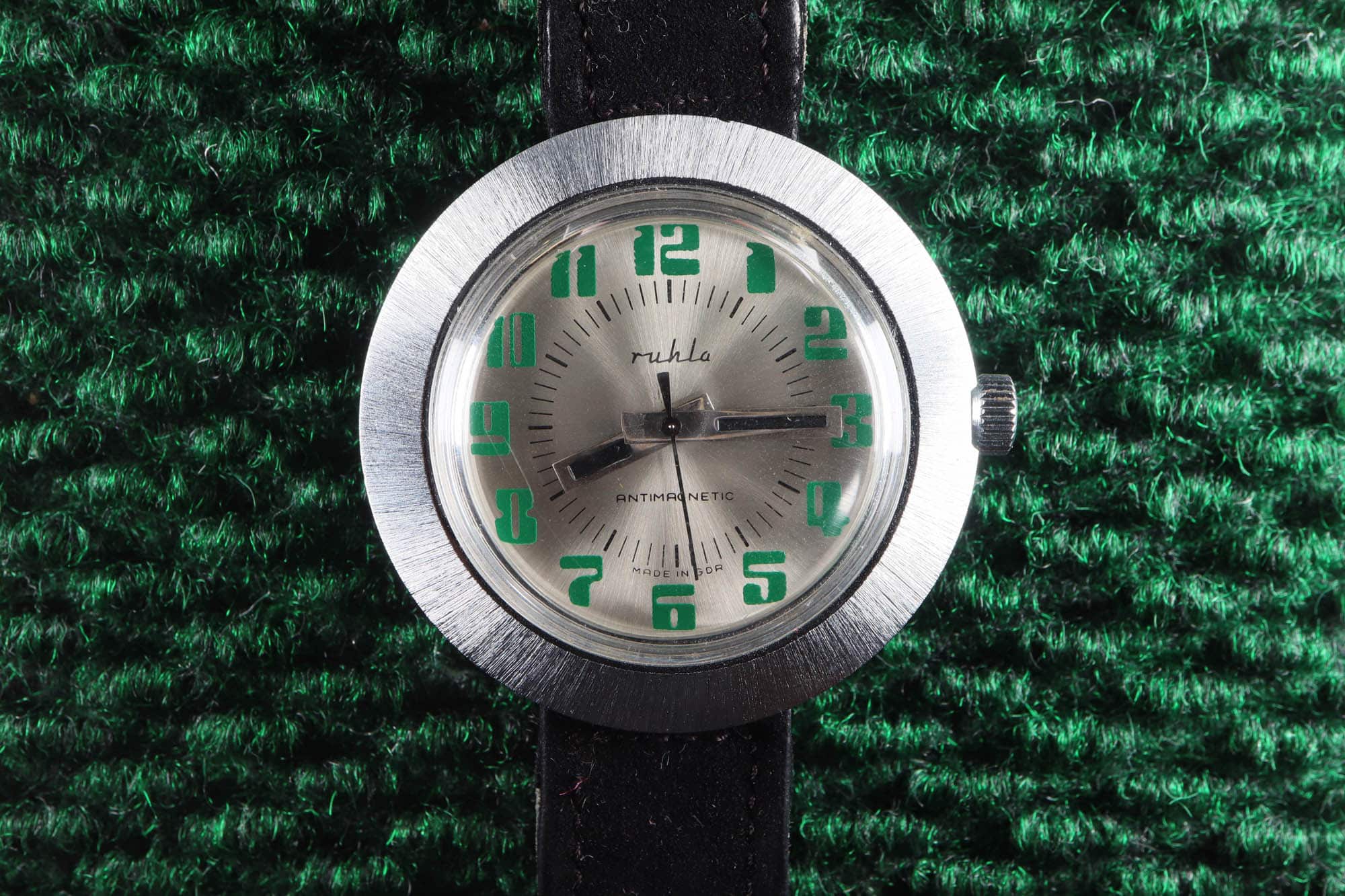
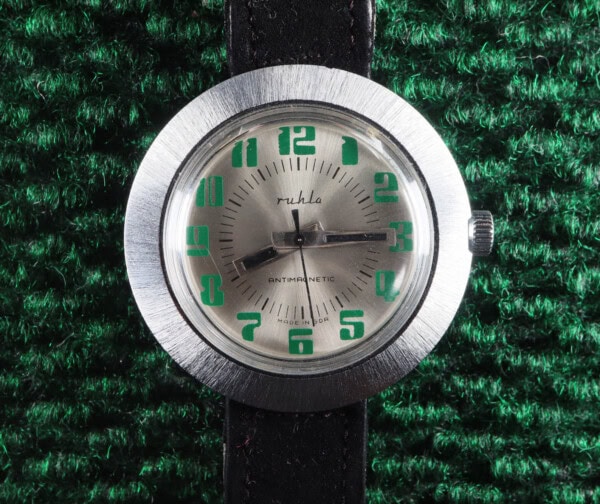
The Gebhard Duve-designed Audemars Piguet Disco Volante 5093 took the horological world by storm in the mid-1950s, and there’s no denying that it remains an exemplar of well-executed watch design today. With the combination of the ongoing Space Race and Mid-century futuristic design movement came an influx of wildly shaped and uniquely proportioned wristwatches throughout the middle portion of the 20th century. One of the most popular designs was the UFO, with brands like Omega, Timex, Zenith, Gruen, and Ruhla employing this case architecture in their 1950s, 60s, and even 70s catalogs. While I’ve had the chance to own a Timex UFO model and handle an Omega Dynamic, it’s the Ruhla you see pictured above that really caught my eye. Why? Let’s dig in.
Brief History of Ruhla and The UFO Model
Ruhla’s watch production, initially named “Gebrüder Thiel GmbH,” began in 1892 with its “Fearless” pocket watch, becoming the first mass-produced timepiece put to market. Fast forward decades later to 1952, and the company is renamed “Uhren und Maschinenfabrik Ruhla,” or Ruhla for short, and continues production of watches and movements for both the domestic East German and international markets. Ruhla quickly found great success throughout this era, with their plant becoming one of, if not the, world’s largest watchmaking factory.
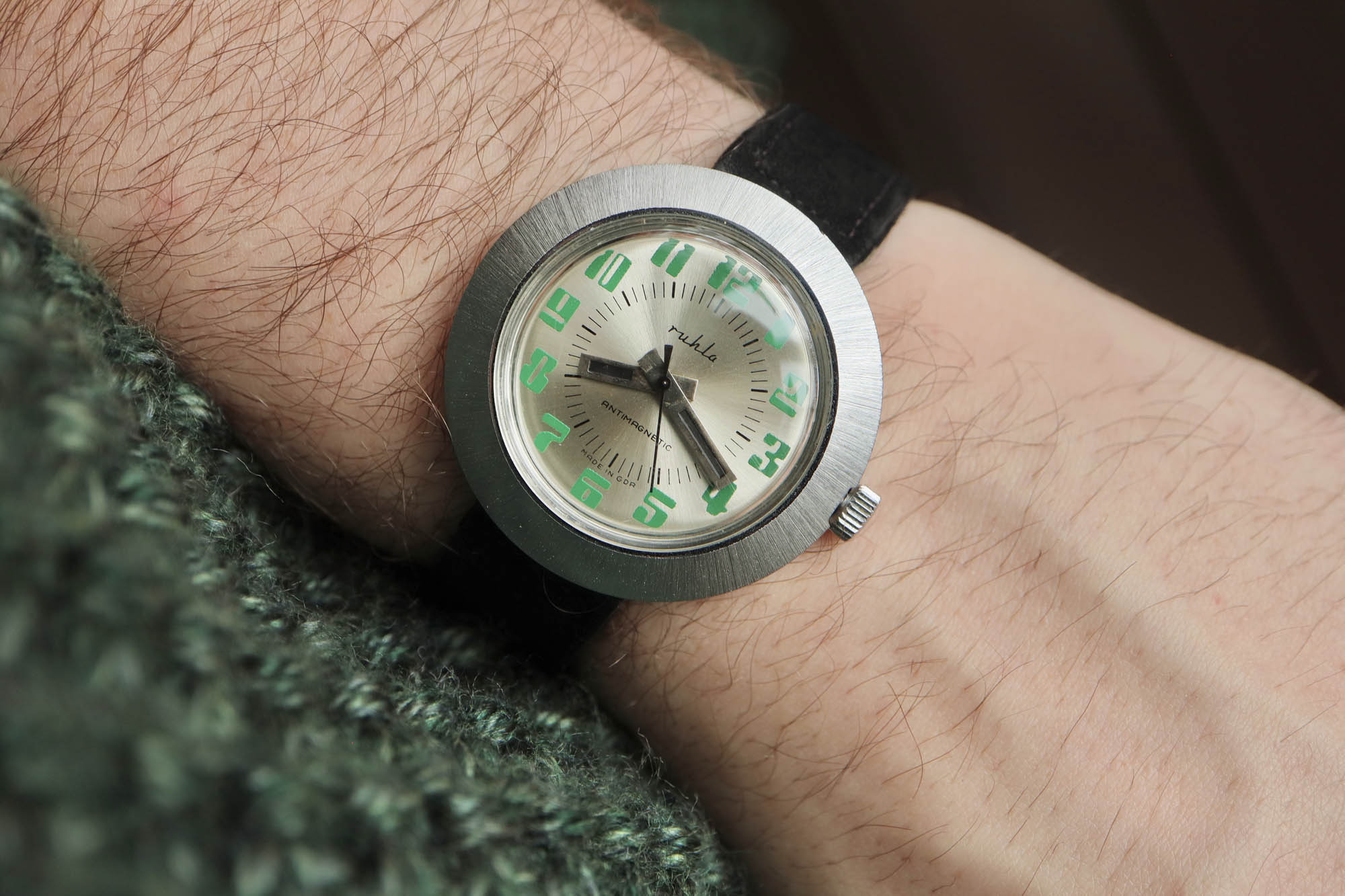
By 1963, the Ruhla logo seen on my UFO example was applied to all the company’s domestic models and was used until the brand’s closure in 1991. For those interested in learning more about the brand’s history, I cannot recommend Grigory Zabelin’s website or our own Blake Z. Rong’s article enough. Ruhla has become heavily underrated and criminally overlooked in the contemporary watch-collecting space. Very few hobbyists remember or discuss the brand’s extensive catalog and monumental historical achievements, so I strongly suggest giving both of these pieces of research and writing a read.
From what I’ve been able to gather from blogs, auction listings, and ownership testimonials, this UFO piece was produced sometime in the late 1960s to mid-70s. According to the Ostalgie-Ruhla Watches of the GDR Database, the watch is listed as having a production date of 1976, but without conclusive evidence from Ruhla’s catalogs or advertisements, I cannot confirm that date. Using this same database, it is clear Ruhla produced other models with a similar, if not identical, case, all of which utilize the Caliber 24 movement (which we’ll come back to shortly). There unfortunately exists no promotional material for this watch or any documentation regarding its design.
The UFO’s Overall Aesthetics
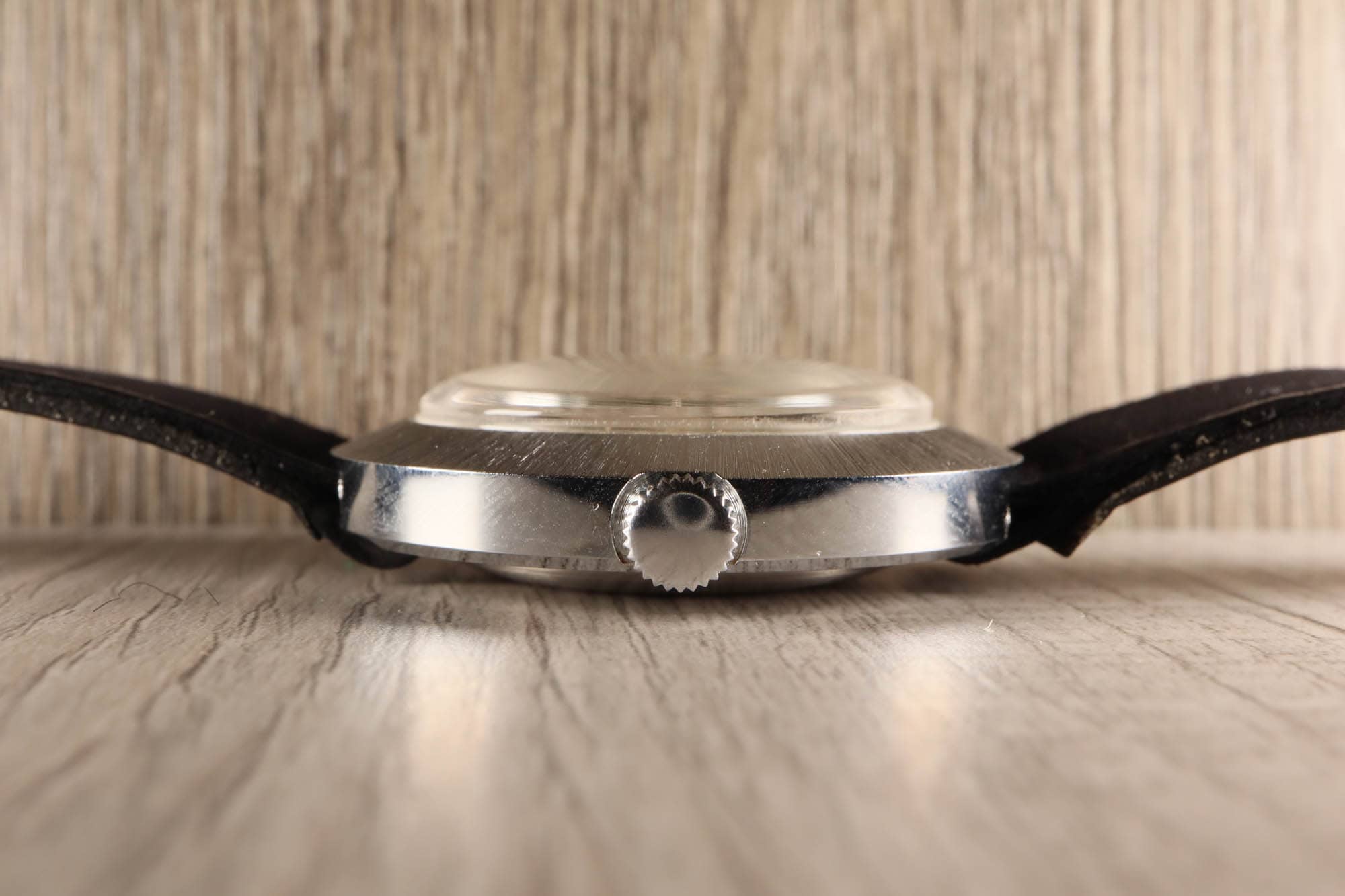
For it being potentially produced in 1976, I couldn’t imagine a more Mod watch. For the historians or patrons of an older generation who may be reading this, you’ll know that the Mod movement in Great Britain started in the late 50s and saw its heyday in the 1960s. So, for a timepiece produced far after this subculture period had already subsided, it leaves me wondering if that 1976 date is true or if East Germany really was just that far behind on contemporary pop and social culture (I’ll side with the latter half here). Let’s start with the star of the show: the case. Measuring in at 36mm in diameter, 36mm lug-to-lug, and with a 18mm lug width, it’s a fantastic fit on most any wrist. The chrome-plated base metal is certainly a worry when it comes to cosmetic condition, so be wary if you ever find yourself hunting for an example on the used market. Mine is thankfully in great shape and still retains the radial burst finishing along the outside of the case’s face.
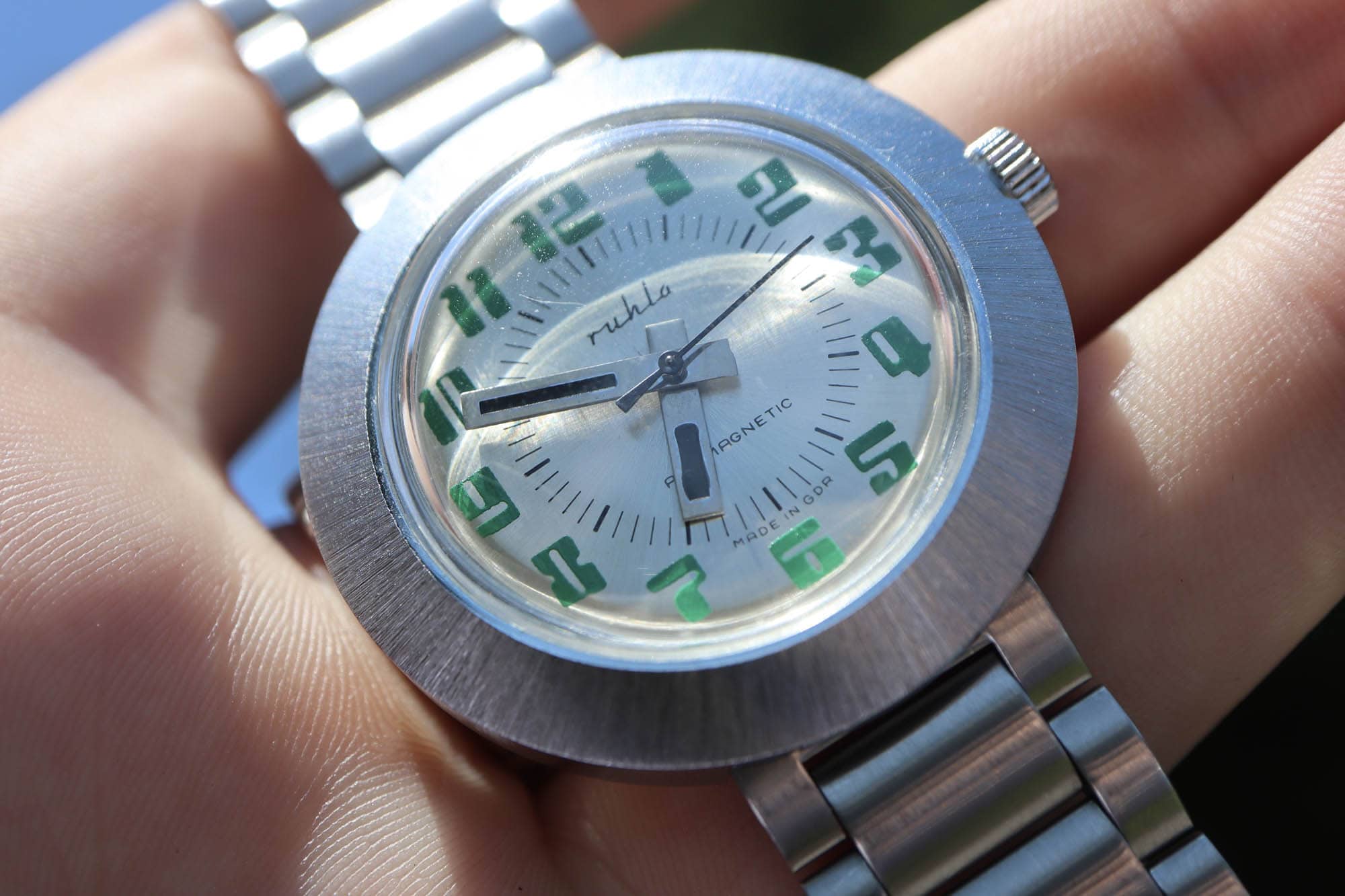
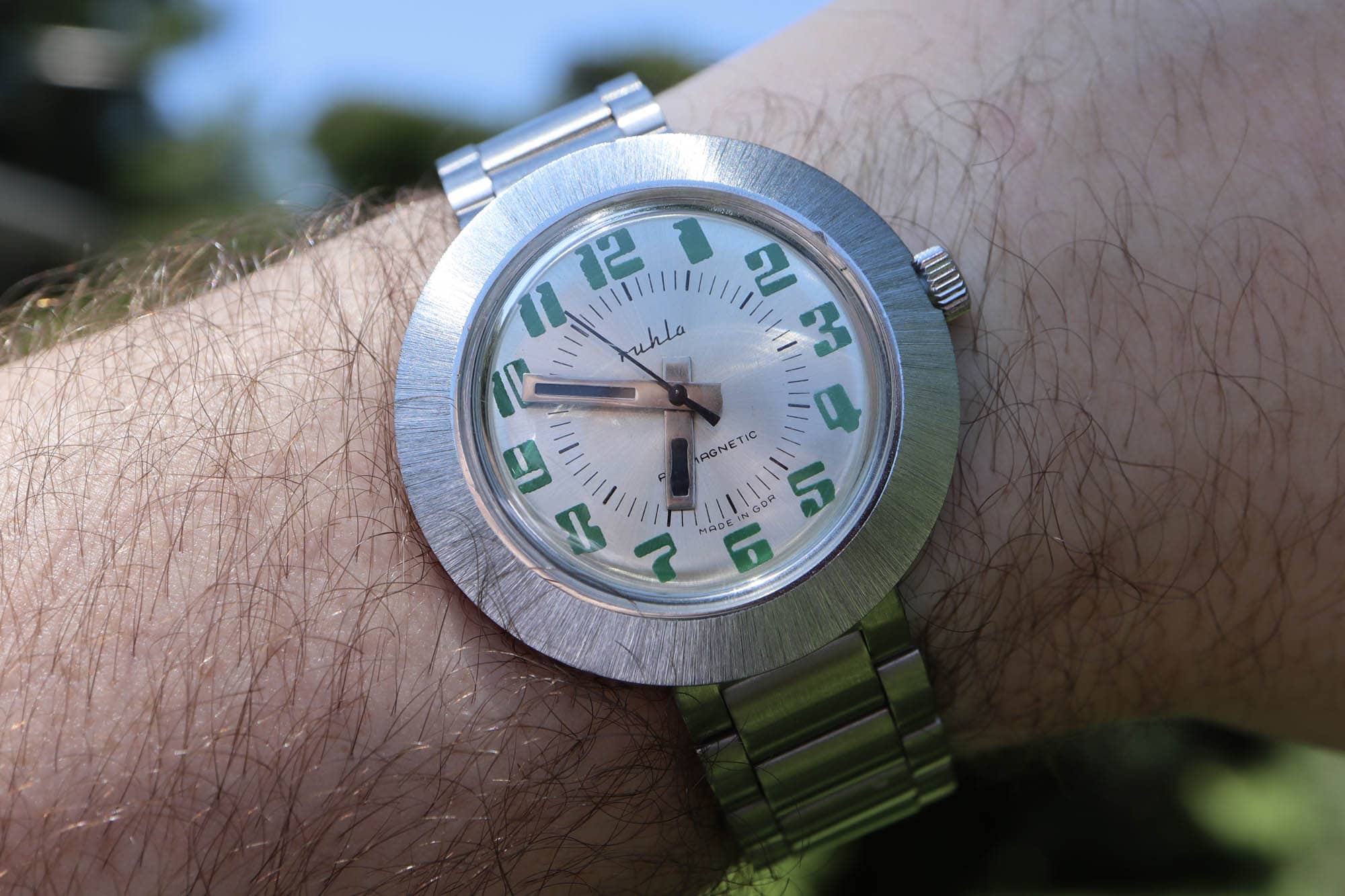
Moving to the dial, its most eye-catching feature is the bright green used to color the very futuristic numerals. It’s a dial that would fit perfectly in any mid-century science fiction flick or on the wrist of a space-age bachelor pad’s owner––truly a time-capsule piece. The pop of color is directly countered by the utilitarian, blocky handset and thin black seconds hand. Besides “Ruhla,” the dial also shows off the movement’s “anti-magnetic” capabilities and proudly advertises its “Made in GDR” origins. The mixture of fonts here is very well done; I’m a fan of how they all clash but somehow look nice all on one dial.
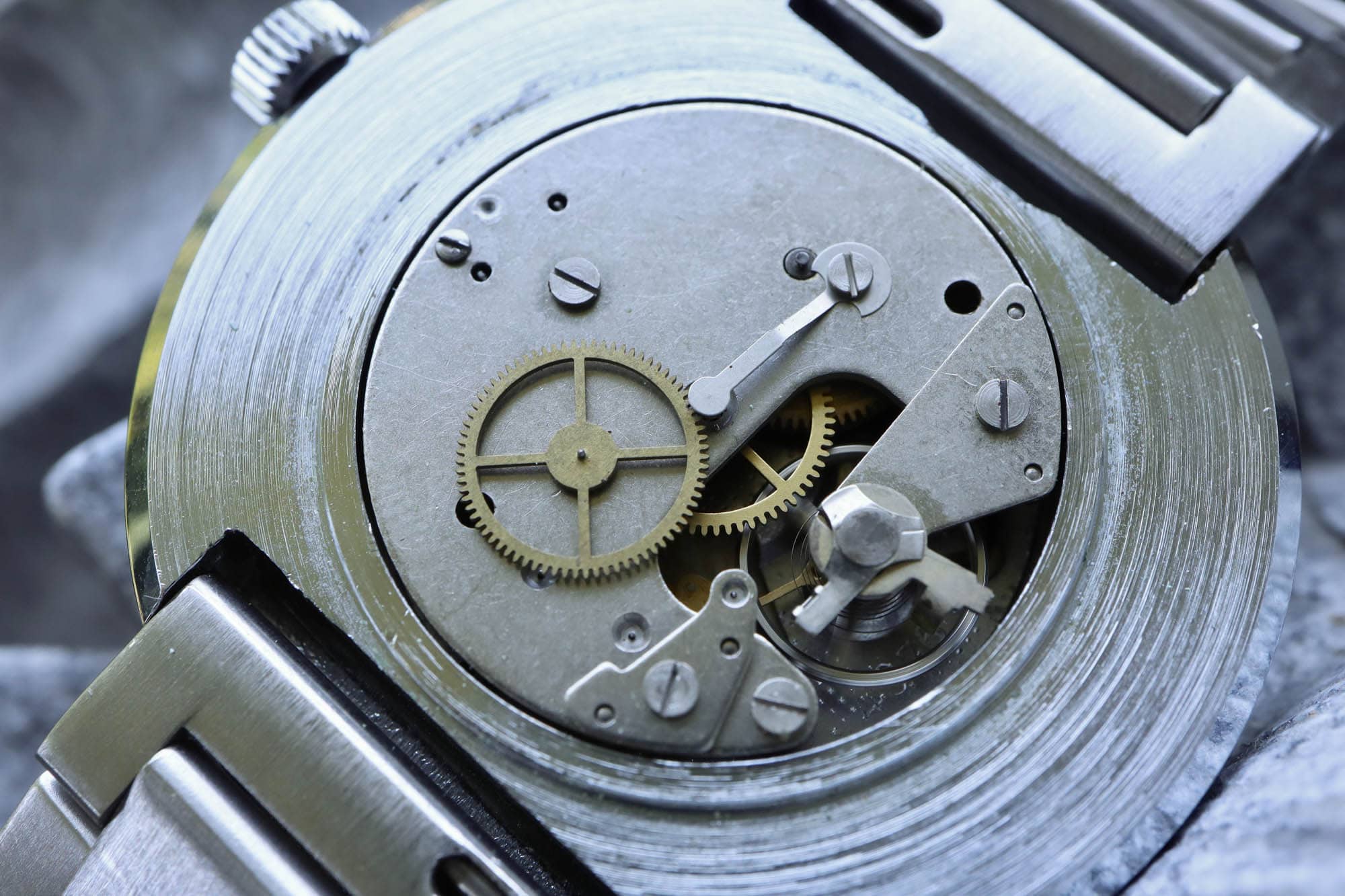
The Caliber 24 powering the UFO was a staple of Ruhla watchmaking. At the center of many models the company produced, this little workhorse of a movement was installed in dozens of models Ruhla made between the 1960s and 1980s. With a 35-hour power reserve beating at 18,000 BPH, it was easily mass-producible for the company due to its low-grade pin pallet and shock-protectionless construction. By the company’s end, it is estimated that they produced and sold roughly 150 million of these movements for use in their own watches and other brands overseas. Sporting a rated accuracy of +240 sec/ –120 seconds a day, it isn’t the most trustworthy piece of timekeeping equipment, but it was certainly the most affordable and easy-to-replace movement in the GDR for its day.
A watch like this will not be a daily GADA wear for the typical collector, but that’s what makes it a neat piece to research and own. Ruhla is a brand, I feel, that deserves far more recognition in the collecting space. Combine this with its very mid-century design aspects and you have a watch that perfectly encapsulates an era of history. It’s not an expensive watch––typically found for under $100 on auction websites––nor is it uniquely rare, but it’s one I recommend keeping an eye out for.